Picpoul de Pinet, Picpoul or Piquepoul?

Table of Contents
Picpoul de Pinet, Picpoul or Piquepoul. Three names, one wine, and a surprising amount of confusion.
The short answer:
- Piquepoul Blanc is the grape
- Picpoul de Pinet is the appellation
- Picpoul is how most people shorten the appellation name
So when someone says they like Picpoul, they almost always mean Picpoul de Pinet. The crisp, dry white from southern France that works brilliantly with seafood.
If you already know that and just want a bottle, you can head straight to our Picpoul wines here.
If not, read on.
Picpoul de Pinet "Soleil" 2023, Languedoc

£13.50
Here is a Picpoul de Pinet in a class of its own. Winner of a gold medal at the Concours Général Agricole Paris. The wine...… read more
Picpoul or Piquepoul, the grape
The grape itself is called Piquepoul.
The origin of the name is unclear, but one popular theory is that chickens (poules) used to peck at fallen grapes. Hence “hen-pecked”. Another, more appealing translation is “lip-stinger”, which makes sense once you taste the acidity.
Over time the spelling Picpoul became common locally, and that spelling carried through into the appellation name. It is also the version most people recognise today.
Piquepoul has a long list of synonyms including Avello, Avillo, Extra, Feher Piquepoul, Languedocien, Picapoll, Picapolla, Picapulla and Picpoul. The last of these is by far the best known in the UK.
The earliest written reference dates back to the 14th century, when Piquepoul Noir appeared in a vineyard rental contract near Toulouse.
Two further mutations, Piquepoul Gris and the now dominant Piquepoul Blanc, followed in the 19th century.
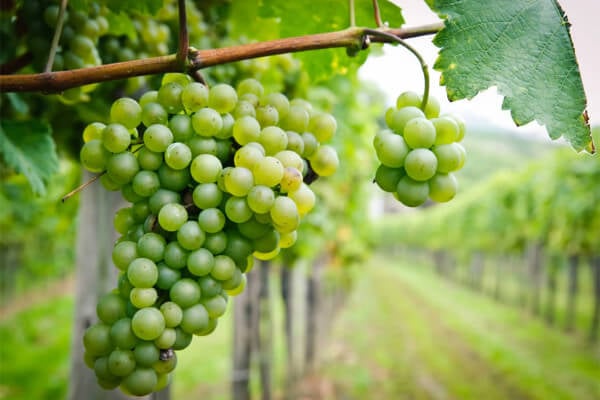 Piquepoul Blanc grapes hanging on the vine
Where does Picpoul grow?
Piquepoul is drought resistant and late ripening, making it well suited to hot, dry climates.
Southern France and northern Spain suit it well.
The largest concentration of vines is in the Languedoc, particularly in the vineyards around the village of Pinet. It is also permitted in Châteauneuf-du-Pape, though it accounts for less than one percent of plantings there.
What does Picpoul taste like?
Picpoul wines are typically clean, fresh and precise.
The grape has thin skins but retains high acidity as it ripens. Young wines show lemon and lime flavours, while older examples lean more towards orange and savoury notes.
Harvest rarely begins before mid-September. The long growing season allows the grapes to benefit from late summer sunshine, cooler evenings, damp nights and coastal air.
The influence of the sea is rarely far away. In the best wines this shows as a subtle saline character.
You will also find stone fruit flavours and Mediterranean herbs such as thyme and sage.
Wines made from Piquepoul Noir are more aromatic and are usually vinified as rosé. These tend to show red fruit and floral notes.
If you are curious, Piquepoul Rosé Foncalieu is a very good example.
Piquepoul Rosé Foncalieu 2024, Languedoc

£14.50
A pale pink in colour, this Piquepoul rosé has a delicate nose of cherry blossom, strawberries and peaches. The palate is wonderfully fresh with summer...… read more
What food should I pair with Picpoul?
Piquepoul wines are a natural match for shellfish and seafood. The classic pairing is Bouzigues oysters from the Bassin de Thau.
As the saying goes, if it grows with it, it goes with it.
More complex examples, particularly those aged on their lees, can handle richer dishes. Strong mountain cheeses and spicy Asian food both work well.
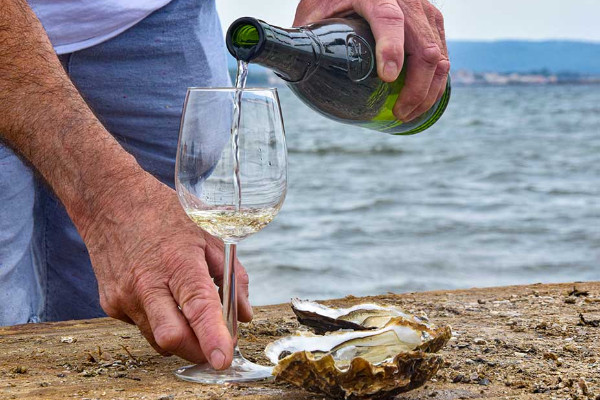 Picpoul served with oysters
Can I age Picpoul?
Most Picpoul is made to be drunk young. The current vintage will be ready by the following spring and is best enjoyed within a year or two.
That said, there is always an exception.
Patience is a collaborative project by Picpoul de Pinet producers designed to show the ageing potential of the grape. These wines often come from older vines and spend extended time on fine lees, giving them more texture and structure.
In June 2023 I tasted two flights of aged Picpoul de Pinet from 2016 to 2022. All retained the hallmark acidity and salty mineral edge. With age, the colour deepened to a rich golden hue.
What stood out most was the savoury development. Smoke, bacon rind, marmite and garrigue herbs all came through.
For committed oenophiles with the patience for Patience, there is real ageing potential here. Only twelve producers make these wines, so they are not easy to find.
If you want to try one, Florensac Picpoul de Pinet “Patience” is the place to start.
Florensac Picpoul de Pinet Selection "Patience" 2022, Languedoc

£19.50
Patience is a new, more gastronomic, style of Picpoul. It is something special for Picpoul lovers in search of the next level. In the glass...… read more
Picpoul de Pinet, the appellation
Picpoul de Pinet is an Appellation d’Origine Protégée in the Languedoc. The vineyards form a triangle between Agde, Pézenas and Sète.
They sit close to the Mediterranean and surround the Bassin de Thau lagoon. The appellation’s tagline is Son terroir c’est la mer. Our terroir is the sea.
At the heart of the appellation is the village of Pinet, on the left bank of the Hérault river. The vineyards extend into Castelnau-de-Guers, Florensac, Mèze, Montagnac and Pomérols.
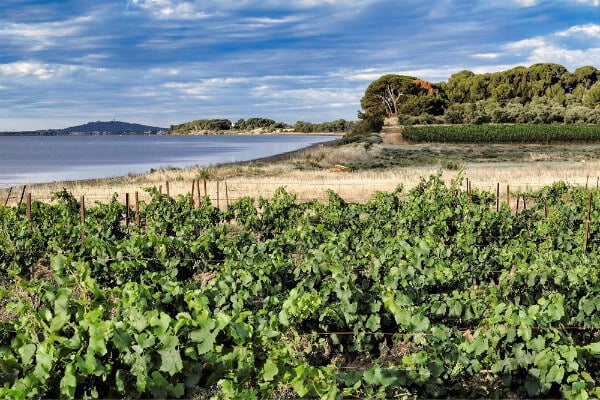 Vineyards surrounding the Bassin de Thau
History
Vines have been grown here since Roman times, when the Via Domitia crossed the region.
The earliest written reference to Picapoll dates from 1384. Picapoll nigri was listed in a vineyard rental contract near Toulouse.
In the 19th century, French drinkers developed a taste for darker red wines. Growers responded by planting Grenache, Carignan and Mourvèdre. Piquepoul Noir fell out of favour.
Lighter coloured mutations were encouraged instead, first Piquepoul Gris and later Piquepoul Blanc.
By the early 20th century, Piquepoul had a poor reputation and was largely used for vermouth. This explains why Noilly Prat is based in the Hérault.
The turnaround began in the 1920s when the growers of Pinet recognised the potential of dry white wines made from Piquepoul Blanc.
In 1954 the region was granted VdQS status. In 1985 it became a sub-region of the AOC Coteaux de Languedoc. Full AOP status followed in 2013.
From workhorse to hero in under a century.
The rules
The French like rules.
Picpoul de Pinet is straightforward. Wines must be dry, white, and made exclusively from Piquepoul Blanc.
It is rare for an appellation to permit only one grape, one colour and one style. It also explains the close link between the grape and the appellation name.
If you see Picpoul de Pinet on the label, you know exactly what you are getting.
The bottle
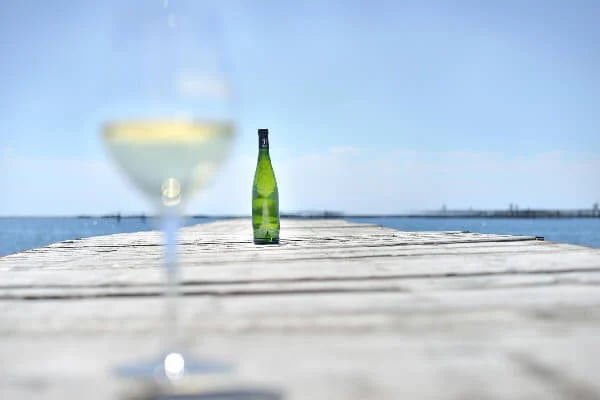
Picpoul de Pinet is easy to spot thanks to its distinctive Neptune bottle, named after the Roman god of the sea.
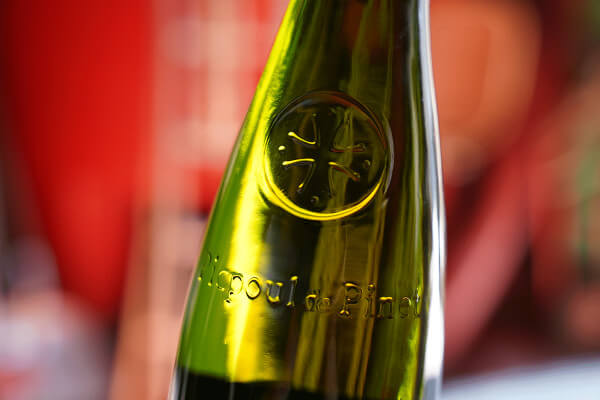 The distinctive Neptune bottle
Each bottle is engraved with “Picpoul de Pinet”, topped with the Languedoc cross and finished with a wave pattern around the neck.
I hope this guide has cleared up the difference between Picpoul, Picpoul de Pinet and Piquepoul, and maybe nudged you towards opening a bottle.
If it has, the shortest route is here:
Buy Picpoul wine online
FAQs
What is the difference between Picpoul and Piquepoul?
Piquepoul is the grape variety. Picpoul is the name used in the appellation Picpoul de Pinet. When people talk about Picpoul, they are almost always referring to wines from the Picpoul de Pinet appellation made from the Piquepoul Blanc grape.
Is Picpoul de Pinet the same as Picpoul?
In practice, yes. Picpoul de Pinet is the full appellation name, and Picpoul is commonly used as shorthand. Both refer to dry white wines from southern France made exclusively from Piquepoul Blanc.
What grape is used in Picpoul de Pinet?
Picpoul de Pinet is made from 100% Piquepoul Blanc. No other grapes are permitted under the appellation rules.
What does Picpoul taste like?
Picpoul is typically dry, crisp and refreshing. Expect citrus flavours like lemon and lime, high acidity, and often a subtle saline note from the coastal vineyards. It is known for being very food friendly.
Is Picpoul always dry?
Yes. Picpoul wines must be dry white wines under the AOP rules. Sweet or off-dry styles are not permitted.
Where is Picpoul from?
Picpoul de Pinet is produced in the Languedoc in southern France, around the Bassin de Thau lagoon near the Mediterranean. The appellation includes the village of Pinet and surrounding communes such as Florensac, Mèze and Pomérols. You can also find Piquepoul grapes grown in other parts of southern France.
What food pairs best with Picpoul?
Picpoul wines are a classic match for shellfish and seafood, especially oysters. Their high acidity also works well with grilled fish, salads, and lighter Mediterranean dishes.